

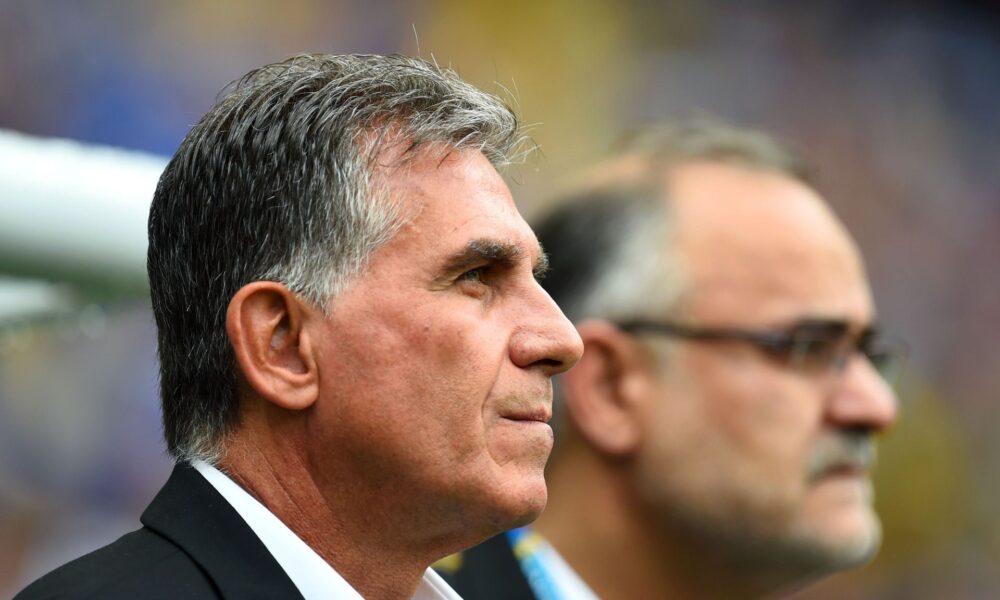
New Black Stars head coach Carlos Queiroz arrives with one of the most extensive FIFA World Cup coaching records in international football, but his track record also reflects a pattern of mixed results at the global stage.
Across five World Cup tournaments with South Africa, Portugal and Iran, Queiroz has built a reputation for discipline, structure and competitiveness, even though progression beyond the group stage has remained limited.
Five World Cups, One Knockout Appearance
Queiroz has coached in five World Cups — 2002, 2010, 2014, 2018 and 2022 — managing a total of 16 matches.
Out of these appearances, his teams progressed beyond the group stage only once — with Portugal at the 2010 FIFA World Cup, where they reached the Round of 16 before being eliminated by eventual champions Spain.
In the other four tournaments, his teams exited at the group stage, often narrowly missing qualification.
Performance Shaped by Preparation Time
A closer look at the data suggests that Queiroz’s performance has been closely linked to preparation time and team stability.
- With South Africa (2002) and Portugal (2010), he had approximately two years to prepare, achieving his best result with Portugal.
- His longest tenure was with Iran (2011–2019), culminating in a strong showing at the 2018 World Cup, where Iran narrowly missed qualification with four points.
- In contrast, his return to Iran for the 2022 World Cup, just months before the tournament, resulted in inconsistent performances, including a heavy 6–2 defeat to England.
Balanced but Modest Match Record
Across all five tournaments, Queiroz’s teams recorded:
- 4 wins
- 4 draws
- 8 losses
His sides scored 19 goals and conceded 19, highlighting a balanced but modest overall performance.
The statistics suggest a coach capable of organising competitive teams, but one who has often struggled to convert performances into consistent victories at the highest level.
Strength in Organisation, Challenges in Progression
Despite the mixed results, Queiroz has consistently demonstrated an ability to make his teams difficult to beat.
His Iran side in 2014 pushed Argentina to a narrow 1–0 loss, while the 2018 team secured a win against Morocco and a draw against Portugal, narrowly missing out on qualification.
However, his record also shows recurring challenges in advancing beyond the group stage, raising questions about attacking output and adaptability against top-tier opponents.
Experience Key for Ghana’s World Cup Ambitions
With Ghana drawn into a challenging 2026 World Cup group that includes England, Croatia and Panama, Queiroz’s experience could prove crucial.
He has previously faced England at the World Cup, suffering a heavy defeat in 2022, while he has yet to face Croatia or Panama in the tournament.
Analysts say his ability to organise teams defensively and manage high-pressure competitions may help Ghana remain competitive, particularly against stronger opponents.
A Calculated Gamble by GFA
The appointment by the Ghana Football Association reflects a strategic decision to prioritise experience and tactical discipline over experimentation.
While Queiroz’s World Cup record may not be exceptional in terms of progression, his depth of experience positions him as a steady hand to guide the Black Stars.
As Ghana prepares for the 2026 FIFA World Cup, the key question will be whether Queiroz can translate his experience into results beyond the group stage.