


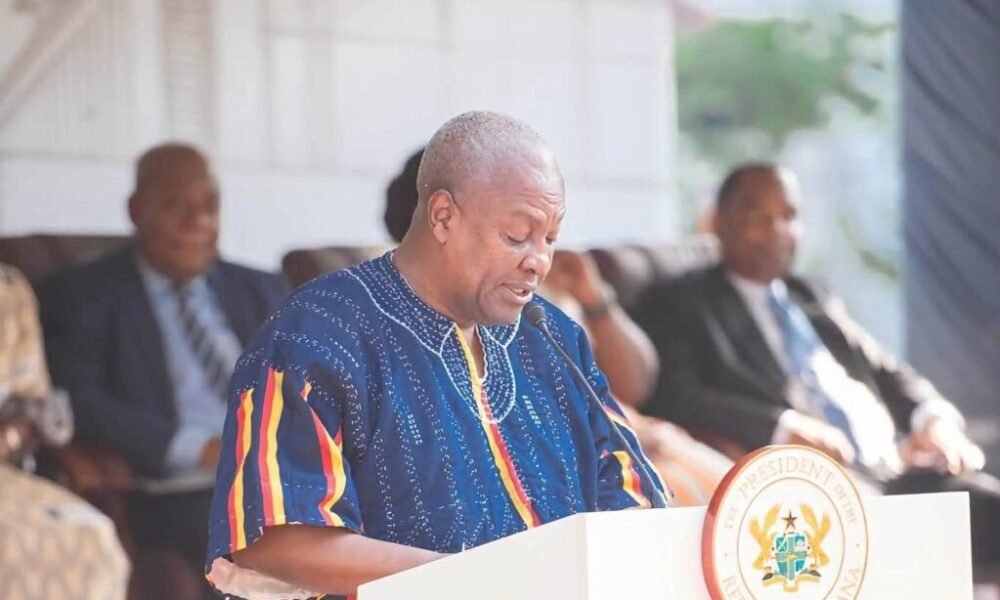
President John Dramani Mahama has commissioned a National Human Identification Laboratory and two advanced vaccine research laboratories at the Noguchi Memorial Institute for Medical Research in Accra.
The facilities are expected to strengthen Ghana’s capacity in forensic investigations, disaster victim identification and vaccine research, while reducing the country’s dependence on foreign laboratories.
Speaking at the commissioning ceremony, President Mahama said the establishment of the DNA laboratory would address a major gap in Ghana’s scientific and forensic capabilities.
He recalled the difficulties encountered following the August 6 tragedy, when human tissue samples recovered from the accident sites had to be sent to South Africa for DNA analysis.
The President described the situation as a national embarrassment and expressed confidence that the new facility would enable Ghana to conduct such investigations locally.
DNA laboratory to support criminal investigations
Beyond identifying victims of disasters, the National Human Identification Laboratory will support criminal investigations involving murder, rape and other offences requiring DNA evidence.
The facility will also provide scientific services for resolving paternity disputes, establishing family relationships and addressing inheritance-related matters.

President Mahama stressed the importance of coordination among institutions using the laboratory to ensure that affected families receive accurate information and timely support.
He urged the relevant agencies to prioritise communication with families alongside the scientific work undertaken at the facility.
Noguchi gets advanced vaccine research facilities
The President also commissioned mRNA and protein research laboratories to strengthen Ghana’s capacity to develop vaccines locally.
He said the COVID-19 pandemic exposed Africa’s dependence on foreign vaccine manufacturers, leaving many countries struggling to access essential vaccines.
According to him, emerging and recurring infectious diseases, including Mpox, Lassa fever, Ebola and Marburg, make it necessary for African countries to invest in local vaccine research and development.
The new facilities will enable Ghanaian scientists to undertake advanced research, test vaccine candidates and collaborate with international partners.
President Mahama disclosed that Ghana is among five African countries using innovative mRNA technology for vaccine research and development.
He commended the National Vaccine Institute for its partnerships with the International Vaccine Institute, Africa CDC and other international organisations.
Five Ghanaian scientists to lead mRNA research training
The President recognised five Ghanaian scientists who received specialised training in mRNA technology in Brussels and Accra.
They are Professor Linda Eva Amoah, Professor Peter Kojo Quashie, Professor Augustina Angelina Sylverken, Dr Ruben Jani-Ayuvo and Dr Festus Kojo Acquah.
The scientists are expected to transfer their knowledge and skills to other researchers to strengthen Ghana’s scientific capacity.
President Mahama said the laboratories would serve as national research facilities, accessible to scientists and researchers from institutions across the country.
Mahama announces $1bn pharmaceutical investment
President Mahama also announced a US$1 billion government investment in the pharmaceutical industry under the Seventh Pillar of the New Economy.
The investment is expected to support the establishment of pharmaceutical and biomanufacturing hubs in the Eastern, Central and Volta Regions.
The initiative forms part of the government’s plans to position Ghana as a pharmaceutical manufacturing centre for West Africa and the wider African continent.
The President further disclosed that the government would spend US$46 million this year to procure vaccines for childhood immunisation.
President calls for public support for vaccine trials
President Mahama urged Ghanaians to support properly conducted clinical trials, describing them as essential to vaccine development.
He recalled an earlier attempt to conduct Ebola vaccine trials in the Volta Region, which was abandoned following public concerns and misinformation.
He explained that Ghana’s ambition to develop vaccines locally would require public confidence in scientific research and participation in clinical trials.
The President emphasised that the newly commissioned laboratories represent an important investment in Ghana’s health security, scientific independence and preparedness for future disease outbreaks.
He subsequently declared the National Human Identification Laboratory and the vaccine research facilities at the Noguchi Memorial Institute for Medical Research officially commissioned.





No Comment! Be the first one.