


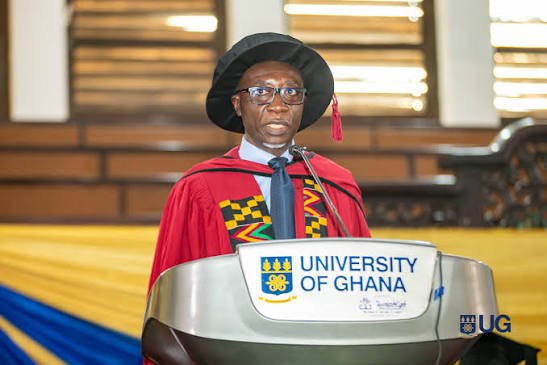
A University of Ghana law professor, Kwadwo Appiagyei-Atua, has criticised the rising cost of student accommodation at the university, arguing that the University of Ghana Enterprises Limited (UGEL) cannot use institutional autonomy to escape regulation by the Rent Control Department.
According to him, UGEL is a private entity legally distinct from the University of Ghana and cannot claim the university’s academic freedom to justify hostel charges that place financial pressure on students.
In a Facebook post titled “UGEL, UG – Different Sides of the Same Coin?”, Prof. Appiagyei-Atua argued that institutional autonomy did not exempt UGEL from the authority of the Rent Commissioner.
“UGEL can only hide under the principle of institutional autonomy inherent in academic freedom to say that the Rent Commissioner’s jurisdiction does not extend to its rental premises,” he stated.
He maintained that UGEL’s separate legal status meant it could not rely on the university’s autonomy to avoid regulatory oversight.
“The fact that a Pro VC of UG is chair of the UGEL board does not grant it that right or immunity from the power that the Rent Commissioner has under the law to stop them from exploiting the students,” he said.
High hostel fees violate students’ academic freedom – Professor
Prof. Appiagyei-Atua argued that the university had a responsibility to protect students’ academic freedom, including ensuring that accommodation challenges did not interfere with their education.
He said excessive hostel charges were forcing some students to seek alternative sleeping arrangements or travel long distances to attend lectures.
“Charging cut-throat rates that force students to sleep in classrooms, chapels and travel long distances to school violates their academic freedom,” he stated.
He questioned how the university could defend its institutional autonomy while students struggled with accommodation costs that affected their academic activities.
“Even where UGEL is part of the university, it cannot claim institutional autonomy (academic freedom for the university) to protect itself while violating the academic freedom of a member of the academic community (students),” he argued.
UG Pro-Vice-Chancellor’s UGEL role raises conflict-of-interest concerns
The professor also raised concerns about the position of the University of Ghana’s Pro-Vice-Chancellor as chair of the UGEL Board.
He argued that the arrangement created a conflict of interest because the university was responsible for protecting students’ welfare while its representative also participated in decisions concerning accommodation charges.
“In fact, the position of the Pro VC as board chair creates a conflict of interest,” he stated.
According to him, the university could not effectively protect students’ interests while simultaneously participating in decisions that increased their financial burden.
Professor accuses UG of attempting to discourage student protests
Prof. Appiagyei-Atua further accused the university of attempting to discourage student groups from protesting against the accommodation charges.
He alleged that the university had involved national security in the matter and made efforts to threaten the Graduate Students’ Association of Ghana (GRASAG), the Students’ Representative Council (SRC) and concerned students over their planned demonstrations.
“UG itself compromised on its autonomy by letting national security in on the matter without invitation,” he claimed.
He also criticised the initial response of GRASAG and the SRC, accusing them of failing to provide strong leadership when students began protesting.
According to him, the determination of concerned students had encouraged other student organisations, including the National Union of Ghana Students (NUGS), to support the campaign.
These allegations represent the professor’s account of events and have not been independently established in the Facebook comments.
UTAG must defend students, not just lecturers – Professor
Prof. Appiagyei-Atua also called on the University Teachers Association of Ghana (UTAG) to support students demanding affordable accommodation.
He argued that lecturers had a responsibility to defend students’ rights rather than concentrating solely on their own welfare.
“So UTAG should also come on the side of the students,” he stated.
He urged the Association to move beyond what he described as an inward-looking approach and become a stronger voice for human rights on university campuses.
“Its time it turned away from its inward-looking approach informed by its welfarist, unionist approach to becoming human rights defenders, a voice for the voiceless on campus and in the larger society,” he said.
The professor also encouraged students to remain united in pursuing their demands.
“You constitute about 80% of the academic community. Without you there’ll be no university and all lecturers will be made redundant,” he told them.
Education Minister intervenes in hostel fee dispute
The professor’s comments come amid growing public debate over accommodation charges at the University of Ghana.
The directive followed a disagreement between UGEL and the Rent Control Department over attempts to inspect university-managed hostels.
The Acting Rent Commissioner, Frederick Opoku, had appealed to the Minister to intervene over what he described as excessive accommodation charges affecting students.
Following the appeal, the Minister tasked Mr Opoku and the Director-General of GTEC, Professor Ahmed Jinapor Abdulai, to examine the concerns and explore appropriate regulatory measures.
Prof. Appiagyei-Atua’s intervention adds to calls for stronger oversight of student accommodation and greater protection of students’ welfare and academic rights.
Howdy, Senanu

Other GCNews



No Comment! Be the first one.