


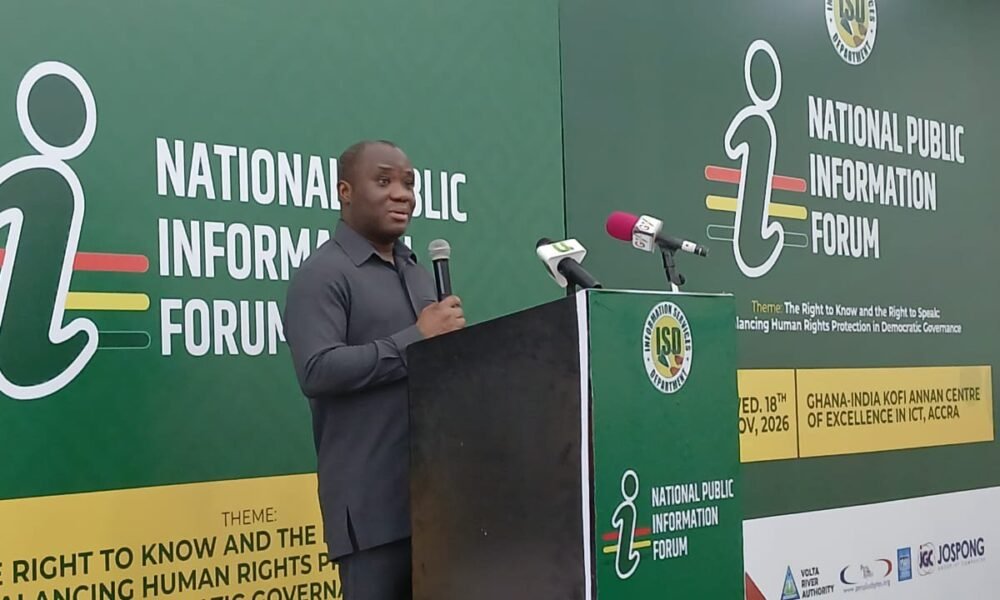
The Minister of State in charge of Government Communications, Felix Ofosu-Kwakye, has warned that the growing spread of artificial intelligence (AI)-generated content, misinformation and disinformation poses a serious threat to public trust and democratic discourse in the country.
He said the rapid growth of digital platforms had made it increasingly difficult for citizens to distinguish credible information from manipulated content, raising concerns about information integrity and responsible communication.
Mr Ofosu-Kwakye raised the concerns at the National Public Information Forum organised by the Information Services Department (ISD) on Wednesday.
The forum was held under the theme, “The Right to Know and the Right to Speak: Balancing Human Rights Protection in Democratic Governance.”
According to the Minister, although digital platforms have expanded opportunities for citizens to access information, express their opinions and participate in national discussions, they have also created new challenges for public trust.
He identified misinformation, disinformation, hate speech and AI-generated content as growing threats that required coordinated action from government institutions, the media, civil society organisations and citizens.
Minister calls for stronger media and information literacy
Mr Ofosu-Kwakye said addressing the challenges would require sustained public education, media and information literacy, responsible journalism and greater transparency from public institutions.
He explained that access to information and freedom of expression were essential to democratic governance because they enabled citizens to scrutinise public decisions, question authority and hold institutions accountable.
However, he emphasised that these freedoms must be exercised responsibly, with respect for the rights and interests of others.
“These freedoms must, however, be exercised with due regard for other rights and legitimate interests, including privacy, human dignity and public safety,” he said.
The Minister also called for improved implementation of the Right to Information (RTI) Act, 2019 (Act 989), urging public institutions to strengthen information management systems, equip information officers and respond promptly to legitimate requests.
He said improving public awareness and information literacy would help citizens access, assess and use information responsibly.
ISD Director warns of growing difficulty in identifying credible information
The Acting Director of the Information Services Department, Dr Winnifred Nafisa Mahama, also expressed concern about the growing influence of social media, messaging platforms and AI-generated content.
She observed that although citizens now had access to more information than ever before, determining which information to trust had become a major challenge.
According to her, misinformation often spreads faster than official communication, making it necessary for public institutions to release accurate information promptly.
Dr Mahama urged government institutions to strengthen their responses to requests made under the RTI Act to promote transparency and public confidence.
“Access, however, should not depend on formal requests only. Proactive disclosure of clear and timely information is our strongest defence against misinformation,” she stressed.
She said the effectiveness of the RTI Act should be assessed by the experiences of applicants, rather than merely the existence of procedures for requesting information.
The Acting Director called for collective efforts involving government institutions, the RTI Commission, the media, civil society organisations, development partners and citizens to promote responsible information sharing.
She also assured stakeholders of the Department’s continued support for public institutions to address administrative challenges, improve records management and assist applicants facing language, literacy or disability-related barriers.
UNESCO urges schools and universities to promote media literacy
The Communications and Information Officer at the UNESCO Ghana Office, Alhaji Abdul Hamid Yakub, called on schools, universities and civil society organisations to strengthen media and information literacy education.
He said improving citizens’ ability to assess information critically was important in an increasingly complex digital environment.
Alhaji Yakub also urged journalists to strengthen public trust through accurate reporting, transparent corrections and resistance to sensationalism.
He further called on digital platforms to take greater responsibility for how information was amplified, labelled and removed.
His remarks highlighted the role of educational institutions in equipping students and the wider public with the skills needed to identify misleading information and engage responsibly with digital content.
ISD calls for stronger public access to information
The Head of the Access to Information Division at the ISD, Bridget Mensah, reaffirmed the Department’s commitment to strengthening public access to information and ensuring that citizens could effectively exercise their right to know.
She encouraged practical engagement between citizens and public institutions to identify challenges confronting information applicants and develop solutions to improve access.
Madam Mensah also urged stakeholders to promote responsible expression, reliable public information and respect for human rights.
She expressed concern about misinformation, harmful speech, abuse and discrimination in the digital space, stressing the importance of protecting citizens’ rights while encouraging responsible communication.
Government developing framework to protect journalists
Meanwhile, Mr Ofosu-Kwakye disclosed that the Office of Government Communications was working towards developing a policy framework to strengthen collaboration between state institutions and civil society organisations in protecting journalists.
He said threats, intimidation and harassment against media practitioners undermined press freedom and restricted public access to information.
“The media plays a critical role in promoting public interest, providing reliable information, and holding institutions accountable. However, threats, intimidation, and harassment against journalists undermine press freedom and restrict public access to information,” he stated.
The Minister explained that the proposed framework would encourage coordinated engagement and strengthen institutional responses to threats against journalists.
He stressed that protecting journalists was essential to maintaining press freedom, promoting accountability and ensuring that citizens continued to receive reliable information.
The National Public Information Forum brought together government institutions, media practitioners, civil society organisations and other stakeholders to discuss ways of strengthening access to information, freedom of expression, information integrity and human rights protection in Ghana.
BoG Clarifies Why Cardinal Dery Was Featured on New GH¢2 Note


No Comment! Be the first one.