


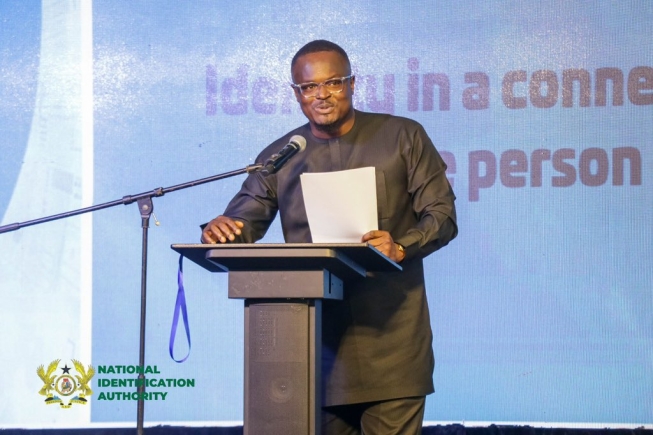
The Executive Secretary of the National Identification Authority (NIA), Mr. Wisdom Kwaku Deku, has stated that Ghana’s national identification system evolved through the efforts of successive governments and should not be credited solely to one individual or administration.
In a detailed social media post, Mr. Deku traced the history of the Ghana Card project from the establishment of the NIA under the administration of former President John Agyekum Kufuor to the nationwide rollout of the current smart card system.
According to him, the NIA was established under the Kufuor administration through the enactment of Act 707 of 2006, with the first phase of registration beginning in 2008 using a centralized biometric system.
Mr. Deku explained that the transition to the current smart card platform began in 2012 when Margins Group proposed a Public-Private Partnership (PPP) model capable of instant card issuance, full biometric capture, e-passport functionality, and other digital services.
He noted that the system was first piloted through the Foreigners Identity Management System (FIMS) before being expanded to support the registration of Ghanaians.
According to him, by the end of 2016, the upgraded system had arrived in Ghana, undergone successful testing, and was ready for implementation.
However, he said the change of government in 2017 led to a temporary suspension of the project while a technical review was conducted.
The review committee eventually recommended that government continue with the existing PPP arrangement and biometric databases rather than develop an entirely new system. The recommendation was subsequently accepted by the Presidency.
“It is the considered view of the Committee that the adoption of option (a) would present the least challenge given that NIA has a functional PPP arrangement. There is also value in the existing NIA data and the other biometric databases built by the various user agencies,” the committee concluded.
Mr. Deku commended the Akufo-Addo administration for continuing with the project despite criticism at the time.
“It is important to commend the NPP Government for continuing with the existing arrangement rather than abandoning the project despite intense public and political criticism at the time,” he wrote.
The NIA Executive Secretary also challenged claims that the Ghana Card project was conceived by a single individual.
“It is therefore inaccurate for some sections of the public to solely credit Dr. Mahamudu Bawumia as the originator or brain behind the NIA project,” Mr. Deku stated.
He further pointed out that Legislative Instrument (LI) 2111, which made the Ghana Card mandatory for identification-related transactions, was passed in 2012 under the Mills-Mahama administration.
Mr. Deku added that a 2015 government directive designated the NIA as the central authority for identity management and data harmonisation, further strengthening the institutional framework for the national identification programme.
Franklin Cudjoe’s Earlier Comments
Mr. Deku’s account aligns with comments made earlier by Franklin Cudjoe, President of IMANI Africa, who also argued that the Ghana Card project predates Dr. Bawumia’s tenure as Vice-President.
In a social media post, Mr. Cudjoe recalled that discussions about a modern national identification system began during the administration of former President Kufuor.
“The Ghana Card? We started conversations about it years before my friend Dr. Bawumia became Vice-President,” he wrote.
Mr. Cudjoe recounted how the late technology entrepreneur Herman Chinery-Hesse introduced him to Moses Baiden, Managing Director of Margins Group, as the developer of what he described as the most suitable identity management solution for Ghana.
While acknowledging Dr. Bawumia’s role in promoting the Ghana Card and driving its adoption across government services, Mr. Cudjoe maintained that he was not the originator of the project.
“He promoted the card, but he didn’t initiate it, nor did he invent it,” Mr. Cudjoe stated.
Call for a Non-Partisan Appreciation
In his concluding remarks, Mr. Deku called for a non-partisan appreciation of the Ghana Card project, arguing that its success was the result of years of policy decisions, technological innovation, and collaboration across multiple administrations.
“The historical facts therefore clearly show that the development of Ghana’s national identity system has evolved through the contributions of multiple governments and administrations over several years.”
“Governance is continuous, and every administration has played a significant role in shaping and advancing the NIA into what it is today.”
His comments have renewed public discussion on the origins of the Ghana Card project and the contributions of various governments, policymakers, and private-sector actors to the development of Ghana’s national identity system.