

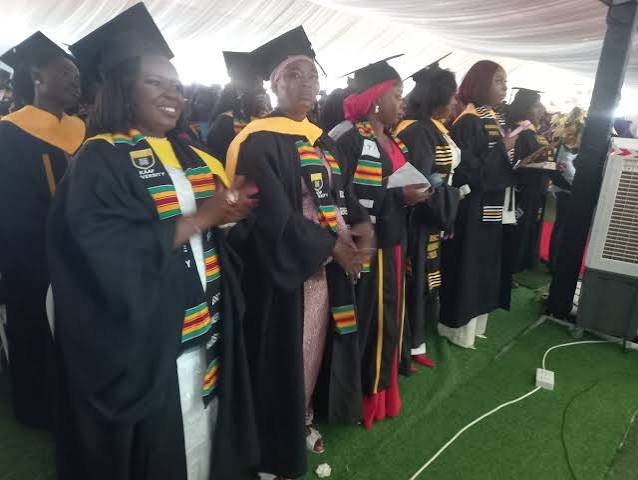
KAAF University has held its first independent congregation, graduating a total of 2,053 students from various undergraduate and postgraduate programmes for the 2025/2026 academic year.
The graduating class comprised 1,953 undergraduate students and 100 postgraduate students, marking a major milestone in the University’s transition to operating under its own academic authority.
The University previously conducted its academic programmes under affiliation arrangements with the University of Cape Coast (UCC) and the Kwame Nkrumah University of Science and Technology (KNUST).
In a sessional address delivered on his behalf, the Vice-Chancellor of KAAF University, Dr Francis Acheampong, said conducting the congregation independently demonstrated the University’s institutional growth and capacity to uphold the standards required of a university.
“This achievement reflects our institutional maturity, and our capacity to uphold the highest standards of university education,” he said.
Dr Acheampong noted that the 2025/2026 academic year was characterised by academic growth, innovation and increased enrolment, with the University recording 3,012 students across its undergraduate and postgraduate programmes.
He also announced that KAAF University has received approval to introduce its first Doctor of Philosophy programme in Nursing, marking another step in the expansion of its postgraduate education and research.
The University has also secured approval to introduce two new postgraduate programmes under the Faculty of Law — LLM and MSc in Alternative Dispute Resolution, and LLM and MSc in Environmental and Resource Management.
On infrastructure development, Dr Acheampong disclosed that the University has procured 500 laptops to support teaching and learning, while construction of an ultra-modern engineering laboratory to strengthen STEM education has reached about 70 per cent completion.
The University has also secured another campus at East Legon to accommodate the growing needs of its School of Law.
KAAF University has further launched its Agenda 20-31 Strategic Plan, which provides a roadmap for academic excellence, research advancement, digital innovation, sustainable infrastructure development, internationalisation and improved student experience.
As part of its digital transformation agenda, the University will introduce a university-wide Artificial Intelligence course for students at all academic levels beginning in the 2026/2027 academic year.
According to Dr Acheampong, the course will provide students across all disciplines with fundamental knowledge and practical understanding of AI, its applications, ethical considerations and implications for society and professional practice.
He urged the graduates to become ambassadors of the University and agents of transformation as they enter the world of work, while continuing to acquire knowledge and adapt to changing professional demands.
“Lifelong learning will keep you relevant and innovative and while at it, you must endeavour to uphold the highest ethical standards in all your dealings,” he said.
“Integrity is a precious asset that will earn you trust, respect, and success throughout your career,” he added.