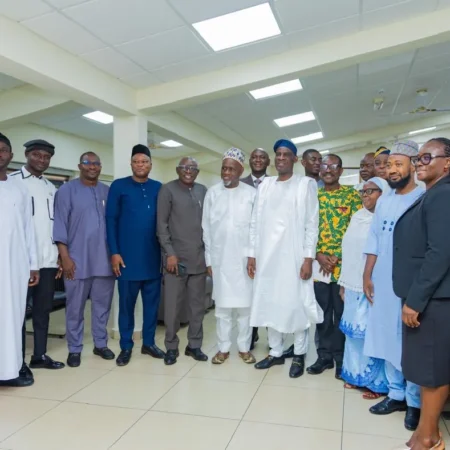



The Department of Physiotherapy and Sports Science (PSS) at the Kwame Nkrumah University of Science and Technology (KNUST) has developed a formal rulebook for the traditional Ghanaian game AMPE, marking a significant step toward recognising the indigenous activity as an organised sport at the global level.
The rulebook, which was introduced to students at the PSS Laboratory (G02) on Friday, February 27, 2026, is the result of five years of research led by the Head of Department, Professor Omoniyi Monday Moses, with contributions from software developer Mr. Emmanuel Amankrah and clinical rehabilitation and exercise specialist Mr. Prince Abraham De-Gualle Deku, according to Focus FM KNUST.
The initiative seeks to transform the popular playground game into a structured competitive sport with standardised rules and officiating systems.
Under the newly developed format, a match will feature two teams of 15 players each, positioned in numbered boxes. Referees known as “Amfre” will officiate the games and enforce penalties for players who move into unauthorised positions.
The gameplay begins with starters from each team competing in box number one. When a starter from one team loses a jump against an opponent, that player moves progressively through the boxes until reaching the final position. A match will consist of five rounds, and teams will be identified as “Opa” and “Oshe” after a coin toss determines the starting side.
Professor Moses explained that the inspiration for developing the sport arose when he tried to understand the Olympic sport curling, which prompted him to reflect on the possibility of Ghana introducing an indigenous game to the Olympic stage.
“Have you seen two people playing AMPE and frowning their faces? No. It’s because research surprised me as to the physiological and psychological benefits of AMPE,” he said.
He added that the development of AMPE as a formal sport could have broader economic benefits.
“The chain of reaction into development of the economy is huge,” he noted.
Professor Moses, however, acknowledged that the project faced several challenges, particularly with funding for the construction of standard AMPE courts and convincing the wider public to accept AMPE as a competitive sport.
“The ultimate aim is to see AMPE sport at the Olympic Games,” he stated.
Mr. Prince Abraham De-Gualle Deku, one of the key officials involved in the development of the sport, said the success of the project reflects the collective effort of students and staff in the department over the five-year research period.
He explained that the long-term vision is to take AMPE from Ghana University Sports Association (GUSA) competitions to national and international platforms.
According to him, the development of the sport could also create employment opportunities for students pursuing Exercise and Sports Therapy, who may be engaged as coaches, referees, trainers and researchers.
Some students who participated in the trials also shared their excitement about the initiative.
Maria Adjin-Tettey, who was part of the winning team during the trials, described the game as demanding.
“It’s a game that requires lots of work and energy,” she said.
Another participant, Gbeblewu Courage Godson, noted that AMPE requires strategy and teamwork.
“AMPE involves lots of thinking, but the cheering from teammates even makes the game more beautiful. All males can try and break the monopoly of football,” he added.
The initiative represents a bold effort to formalise and globalise a traditional African game, positioning AMPE as a potential future sport on international competitive platforms.
Other GCNews
Speaker Bagbin Hosts Jamiat Alhidaya Girls SHS Students