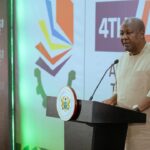


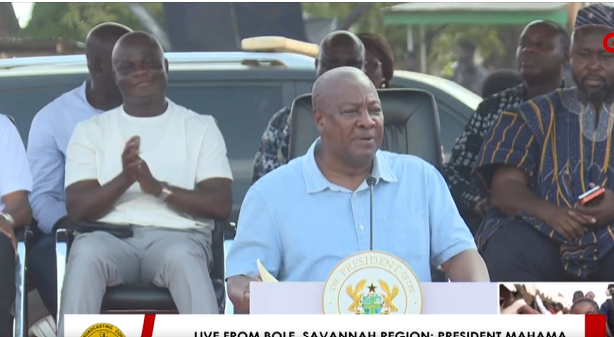
President John Dramani Mahama has called for the democratisation of Science, Technology, Engineering and Mathematics (STEM) education, stressing that access to STEM learning must extend beyond a few specialised schools to every child in Ghana.
Speaking during a BSTEM demonstration in Sawla, the President said government is committed to decentralising STEM education and making it practical, inclusive, and accessible at the basic school level.
According to him, the traditional approach to teaching science and mathematics often discouraged students because it focused heavily on theory rather than practical application.
He noted that the new approach allows pupils to interact directly with scientific concepts through hands-on learning.
“Instead of merely reading about science, students can now see, touch and experiment with what they are learning,” he said.
President Mahama cited classroom demonstrations, including the use of litmus tests to identify acids and bases, as examples of how experiential learning can improve understanding and stimulate interest in science.
He disclosed that government is developing a new curriculum that will fully integrate STEM education, including emerging fields such as artificial intelligence (AI) and robotics.
The President further revealed that more than 5,000 schools have already been equipped under the initiative, with plans to expand the programme to schools across the country.
He emphasised that strengthening literacy, numeracy, and critical thinking skills at the foundational level remains essential to improving educational outcomes and preparing students for future careers.
The BSTEM initiative forms part of government’s broader efforts to equip young Ghanaians with the skills needed to thrive in an increasingly technology-driven world.