



The University of Ghana has emerged as the highest-ranked university in Ghana and West Africa and placed 8th in Sub-Saharan Africa in the QS Inaugural QS World University Rankings: Sub-Saharan Africa 2026, scoring 74.8 overall across nine performance indicators.
The ranking was announced at the launch event hosted by the Association of African Universities in Accra. A total of 69 institutions from 21 African locations were assessed.
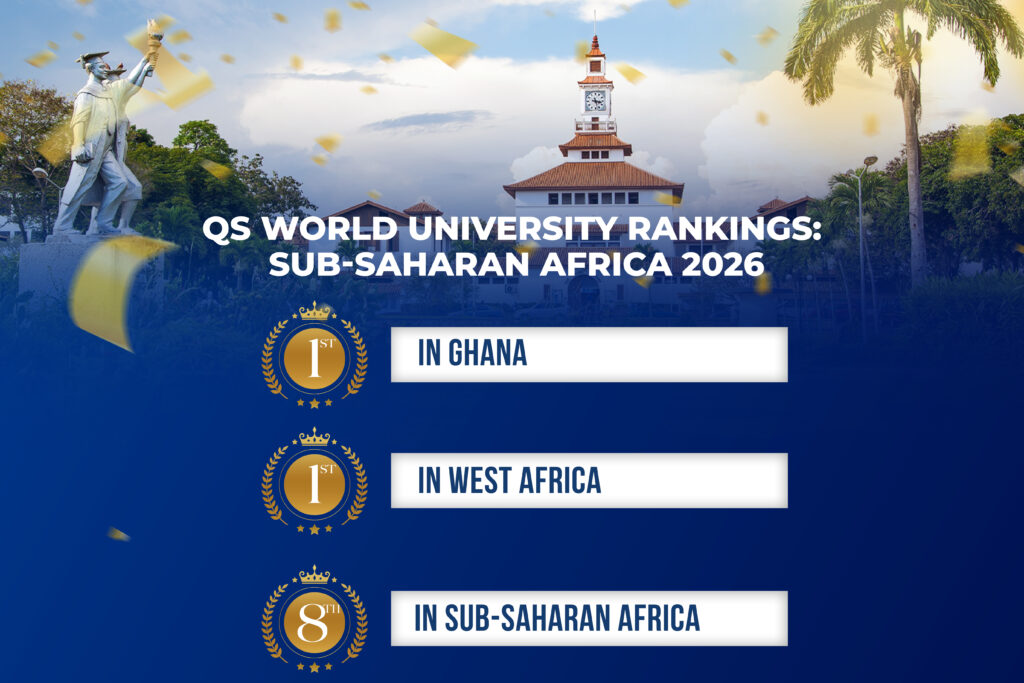
Where UG Scored Highest — and Lowest
According to the published indicator scores:
- Academic Reputation: 90.6
- International Research Network: 88.3
- Sustainability: 86.6
- Web Impact: 79.2
- Employer Reputation: 65.6
- Citations per Paper: 52.1
- Staff with PhD: 50.3
- Papers per Faculty: 48.1
- Faculty–Student Ratio: 10
The data shows UG’s strongest performance in academic reputation (90.6), signalling high peer recognition among scholars. It also recorded robust scores in international research collaboration (88.3) and sustainability (86.6).
However, the lowest score — 10 in Faculty–Student Ratio — indicates structural pressure in staffing levels relative to student enrolment.
VC Flags Staffing Gap
Reacting to the ranking, Vice-Chancellor Prof. Nana Aba Appiah Amfo described the 8th-place position as “a collective success,” but acknowledged areas requiring improvement.
She pointed specifically to the faculty–student ratio and called for greater investment and government clearance to recruit additional academic staff. Increasing staffing levels, she said, would ease workloads and allow faculty to dedicate more time to research — a move likely to improve indicators such as papers per faculty (48.1) and citations per paper (52.1).
What the Numbers Suggest
The 74.8 overall score reflects strong regional positioning, particularly in reputation and global engagement metrics. However, mid-range scores in research output indicators — including citations and publication intensity — suggest room for growth in research productivity per faculty member.
The faculty–student ratio score of 10 stands out in contrast to the high academic reputation score of 90.6, indicating that while UG enjoys strong scholarly esteem, expansion in enrolment without proportional faculty growth may be affecting structural metrics.
Regional Context
The Sub-Saharan Africa ranking framework was adapted to reflect regional higher education realities, including:
- Research output
- Reputation among academics and employers
- Employability
- Sustainability
- Global engagement
QS stated that its rankings measure metrics that matter to students, including research performance and employer perception.
With 69 institutions ranked, UG’s 8th-place position places it in the top 12% of ranked universities in Sub-Saharan Africa, based strictly on ranking order.
Looking Ahead
Prof. Amfo urged faculty, staff and students to remain committed to excellence, stating that with adequate resources and unity of purpose, the University can aspire to the top position in future editions.
The data suggests that improvements in staffing levels and research intensity could significantly influence UG’s trajectory in subsequent rankings, given its already high reputation and international collaboration scores.