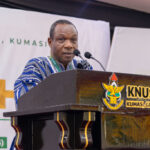



Students of the Kwame Nkrumah University of Science and Technology (KNUST) who fail to sign the matriculation register will no longer be allowed to graduate, following the introduction of a mandatory compliance provision under the University’s new Act 2025.
The provision was disclosed by Chairman of the Act and Statutes Committee, Professor John Tiah Bugri, during the launch of the University Act 2025 and KNUST’s Corporate Strategic Plan, PLAN2K35. According to him, the Act “makes it mandatory for students to sign the matriculation register, with failure to do so disqualifying a student from graduating.”

The requirement represents a significant tightening of administrative compliance for students and signals a move by the university to enforce formal registration processes more strictly as part of broader governance reforms.
Professor Bugri explained that the new Act introduces several structural changes aimed at strengthening accountability and order within the institution. In addition to the matriculation requirement, the law provides for the establishment of a University Court, to be headed by a “highly reputable judge,” to adjudicate internal disputes, formalising processes that were previously handled administratively.
The Act also revises leadership and oversight arrangements. Professor Bugri announced that the tenure of the Registrar and Finance Officer has been reduced from five years to four years, although current office holders will be allowed to complete their existing terms. He further revealed that while KNUST initially sought approval for two Pro Vice-Chancellors, Council opted for flexibility.
“As a result, the number of Pro Vice-Chancellors is open-ended,” he said, noting that the approach allows the university to respond to growth in student numbers and administrative demands without frequent amendments to the law.
Chairman of the University Council, Akyamfuo Asafo Boakye, described the launch of the Act as a turning point, stating that “institutions that wish to remain relevant must be willing to innovate,” and adding that the reforms would serve as a catalyst for development.
The governance changes are being implemented alongside PLAN2K35, KNUST’s new long-term strategic framework. Chairman of the Strategic Plan Committee and Pro Vice-Chancellor, Professor David Asamoah, said the plan aims to move the university “from excellence to eminence,” positioning it to address global challenges such as technological disruption and climate change.

Vice-Chancellor Professor Rita Akosua Dickson said the Act responds to the evolving demands on tertiary institutions and emphasised execution over policy declarations. “KNUST does not want to hallucinate, we want to get the job done,” she said, calling on students, staff and stakeholders to comply fully with the new rules and help translate policy into action.
Other GCNews

KNUST Student Creates Eco-Friendly Mathematical Set
KNUST to Establish University Court Under New University Act