


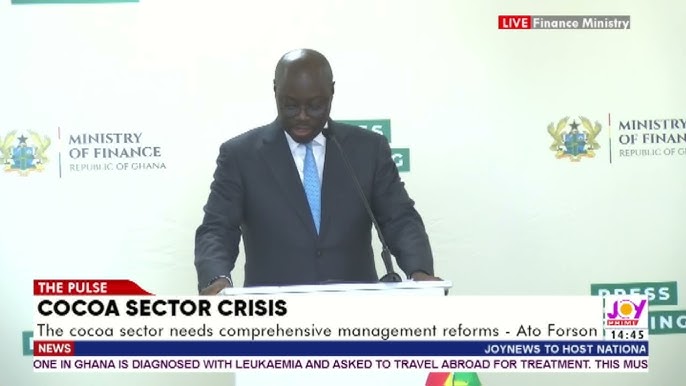
Ghana has reduced its cocoa producer price by 28%, from GH¢58,000 to GH¢41,392 per metric ton, after global cocoa prices fell by about 43% from US$7,200 to roughly US$4,100–US$4,200 per metric ton, according to figures announced at a press briefing by the Finance Minister on Thursday, February 12, 2026.
The new producer price translates to GH¢2,587 per bag, effective immediately for the remainder of the 2025/2026 crop season, the Minister said.
“There is no point when the world market price is an average of $4,200 per metric ton to buy your cocoa at $7,200 per metric ton,” he stated, explaining the basis for the downward adjustment.
Price Math: From GH¢58,000 to GH¢41,392
According to the Minister’s presentation:
- The previous producer price of GH¢58,000 per ton was set after a review that reflected an exchange rate of GH¢11.5 to US$1.
- At the time, global cocoa prices averaged US$7,200 per ton.
- With prices now averaging about US$4,200 per ton, Ghana’s earlier farmgate price had become “uncompetitive and very expensive,” he said.
The new rate of GH¢41,392 per ton reflects what the Producer Price Review Committee (PPRC) described as 90% of the achieved gross FOB price of US$4,200 per ton, converted at the prevailing exchange rate.
The Minister, who chairs the PPRC, said the 90% payout was intended to cushion farmers despite falling international prices.
“Being mindful of the impact on the farmer… we pushed so that the cocoa farmer gets 90% of the achieved gross FOB,” he said.
Production Miss: 45% Below Projection
Beyond price pressures, the Minister disclosed a severe production shortfall for the 2023/2024 crop season.
- Projected output: 800,000 metric tons
- Actual production: 432,145 metric tons
- Deviation: Over 45%
He noted that typical forecast deviations range between 5% and 15%, describing the 45% shortfall as “unprecedented and unacceptable.”
The production miss resulted in rollover contracts of approximately 333,767 metric tons, priced at an average of US$2,661 per metric ton.
With global prices later rising above US$8,000 per ton at their peak, the Minister said the rollover position contributed to losses exceeding US$1 billion.
“This resulted in a loss of over one billion United States dollars,” he stated, adding that the loss could have gone to farmers or other sector stakeholders.
Liquidity Strain and Debt Exposure
The briefing also detailed the financial strain at Ghana Cocoa Board (COCOBOD).
Cabinet has directed that legacy debt of about GH¢5.8 billion be converted onto the balance sheets of the Ministry of Finance and the Bank of Ghana.
According to the Minister:
- COCOBOD owes the Ministry of Finance GH¢3.7 billion, arising from the conversion of non-marketable cocoa bills.
- It also owes the Bank of Ghana GH¢1.38 billion under a 10-year loan.
- In July 2024, COCOBOD failed to pay the final tranche of its syndicated loan and required a US$70 million bridge facility from the Ministry of Finance.
He said the debt conversion would “restore positive equity” and strengthen COCOBOD’s balance sheet.
Road Contracts: GH¢26.5bn Awarded, GH¢4.35bn Remaining
The Minister attributed a significant portion of COCOBOD’s financial difficulties to road construction liabilities.
He disclosed that between 2014 and 2024, cocoa road contracts totaling GH¢26.5 billion were awarded, with GH¢21.5 billion of those awarded between 2018 and 2021.
Under an IMF programme in 2023, commitments of GH¢21.7 billion were to be rationalised to GH¢6.9 billion. However, he said this was not completed until recently.
Following a joint exercise by the Ministry of Finance and the Ministry of Roads, exposure was reduced to GH¢4.35 billion, which Cabinet has directed be transferred to the Roads and Finance Ministries.
“Road construction accounts for a significant part of the financial difficulties that COCOBOD is facing,” he stressed.
Smuggling Incentives Reversed
The Minister also cited cross-border cocoa sales data to illustrate price distortions.
- In the previous crop year, 97 metric tons were reportedly sold to Ghana Cocoa Board from neighbouring sources.
- In the current crop season, that figure has risen to 2,500 metric tons.
He attributed the increase to Ghana’s previously higher producer price.
“If care is not taken we see reverse smuggling coming into our economy,” he said.
New Financing Model: Domestic Cocoa Bonds
The government will introduce domestic cocoa bonds to replace the collapsed syndicated loan model, which had operated for 32 years.
The bonds will be issued on COCOBOD’s balance sheet to finance cocoa purchases within each crop year. The Minister said the previous buyer-pre-financing model had proven “not sustainable.”
50% Local Processing Mandate
Beginning with the 2026/2027 crop season, at least 50% of Ghana’s cocoa beans must be processed locally, under a policy to be embedded in a new cocoa bill to be presented to Parliament.
For the remainder of the current season, all unsold beans will be allocated for domestic processing.
Automatic Price Adjustment in Law
In response to concerns that farmers did not benefit when global prices previously rose, the Minister said the forthcoming legislation would guarantee farmers a statutory minimum of 70% of gross FOB price, with automatic price adjustments linked to world prices and exchange rates.
“Never again should this practice be allowed to persist,” he said.
The combination of a 43% global price decline, a 45% production shortfall, and multibillion-cedi debt restructuring marks one of the most turbulent periods in Ghana’s cocoa sector in recent years, according to figures presented at the briefing.
Other GCNews