


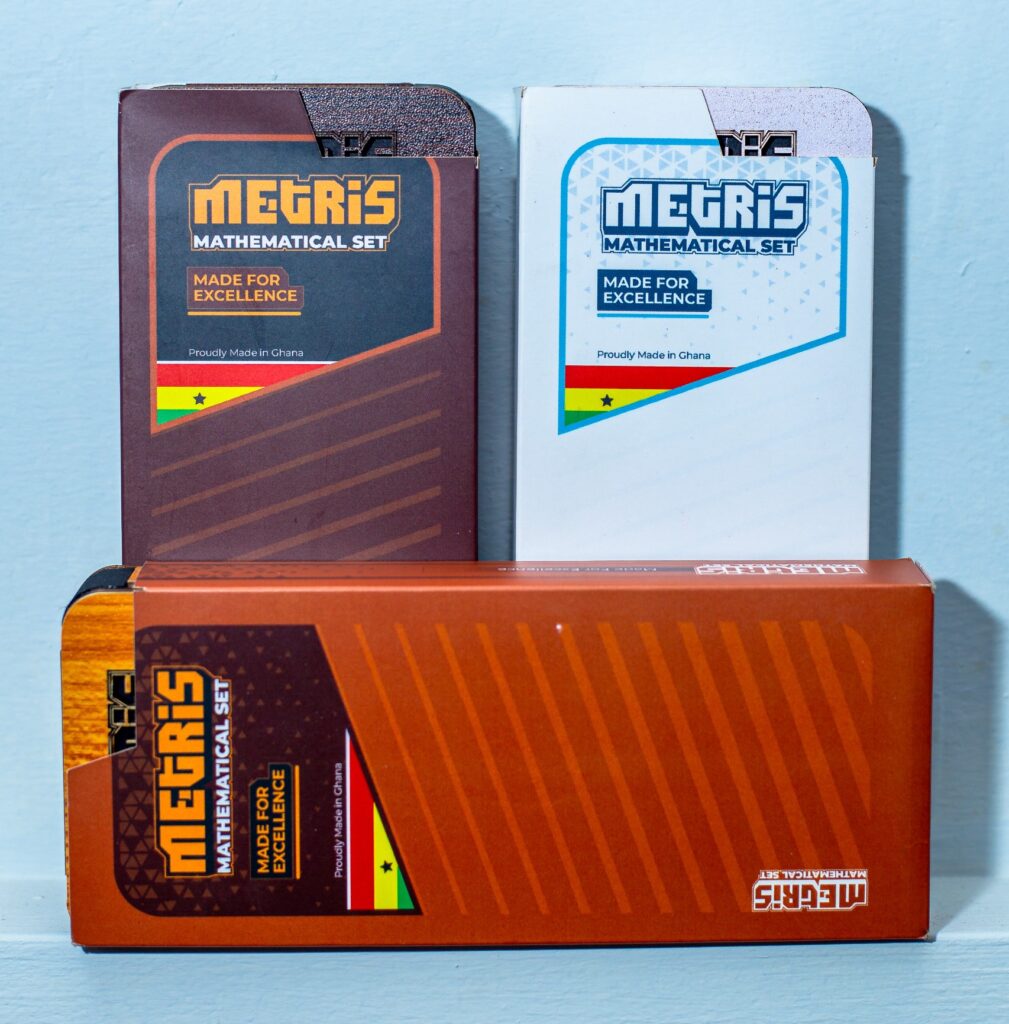
A third-year Information Technology student of the Kwame Nkrumah University of Science and Technology (KNUST), Sabbathsian Asante Bonsu, is gaining recognition as a young achiever after developing an eco-friendly mathematical set using locally sourced materials, highlighting the growing role of student-led innovation in higher education.
Mr Bonsu’s project, which replaces imported plastic mathematical sets with biodegradable, smooth-edged alternatives, began from a personal curiosity about why everyday educational tools used in Ghana are largely imported. He said the innovation reflects a belief that local creativity can produce affordable and safer learning materials for students.
The mathematical set, which is fully functional, is designed to reduce injuries often associated with sharp components found in many foreign-made sets, while also addressing environmental concerns linked to plastic use. Mr Bonsu explained that the idea goes beyond a single product and seeks to demonstrate that Ghana can design and manufacture its own educational tools.
Director of Student Affairs at KNUST, Professor Marian Asantewah Nkansah, described the student’s work as a clear example of practical innovation by young people. “It’s transforming something that is already known but with innovative ways of doing it, and that is the novelty,” she said, noting that the project reflects creativity grounded in real-world needs.
Professor Nkansah added that the Directorate is committed to supporting talented students whose initiatives combine academic learning with practical application. She said the innovation presents “an opportunity for all KNUST students who do exploits to tell the rest of the university community of what they have done,” expressing hope that such visibility would create opportunities for Mr Bonsu beyond the university.
Mr Bonsu’s journey into innovation began early, shaped by an interest in technology and design and later strengthened through mentorship in 3D modelling and fabrication. His persistence following an initial setback in gaining university admission, and his subsequent success at KNUST, have been cited as key factors in his development as a young innovator.
At KNUST, his technical skills have already found application beyond the classroom, including designing and welding more than 200 tent corner structures used during the university’s 59th Congregation, underscoring his ability to translate ideas into practical solutions.
As he continues to refine the eco-friendly mathematical set, university officials say his achievement exemplifies how young people can combine innovation, sustainability and local problem-solving, reinforcing the role of students as contributors to national development rather than passive learners.
Other GCNews